
Explore Unit Categories
Unit Conversion Formulas Explained – Complete Guide with Examples, Tables and Step-by-Step Methods
Introduction
Unit conversion formulas are essential tools used in everyday life, science, engineering, and many professional fields. Whether you are converting distance, weight, volume, or temperature, understanding the formulas behind these conversions ensures accuracy and confidence.
While many people rely on calculators or online tools, knowing how conversion formulas work gives you a deeper understanding of measurements and helps you avoid errors. This comprehensive guide explains the most important unit conversion formulas, how they work, and how to apply them step by step.
What Is a Unit Conversion Formula?
A unit conversion formula is a mathematical expression used to convert a value from one unit to another while preserving its meaning. These formulas are based on fixed relationships between units.
For example:
- 1 kilometer = 1000 meters
- 1 kilogram = 2.204 pounds
- 1 liter = 1000 milliliters
General Conversion Formula
New Value = Original Value × Conversion Factor
The conversion factor is the ratio between two units. Using the correct factor is the key to accurate conversion.
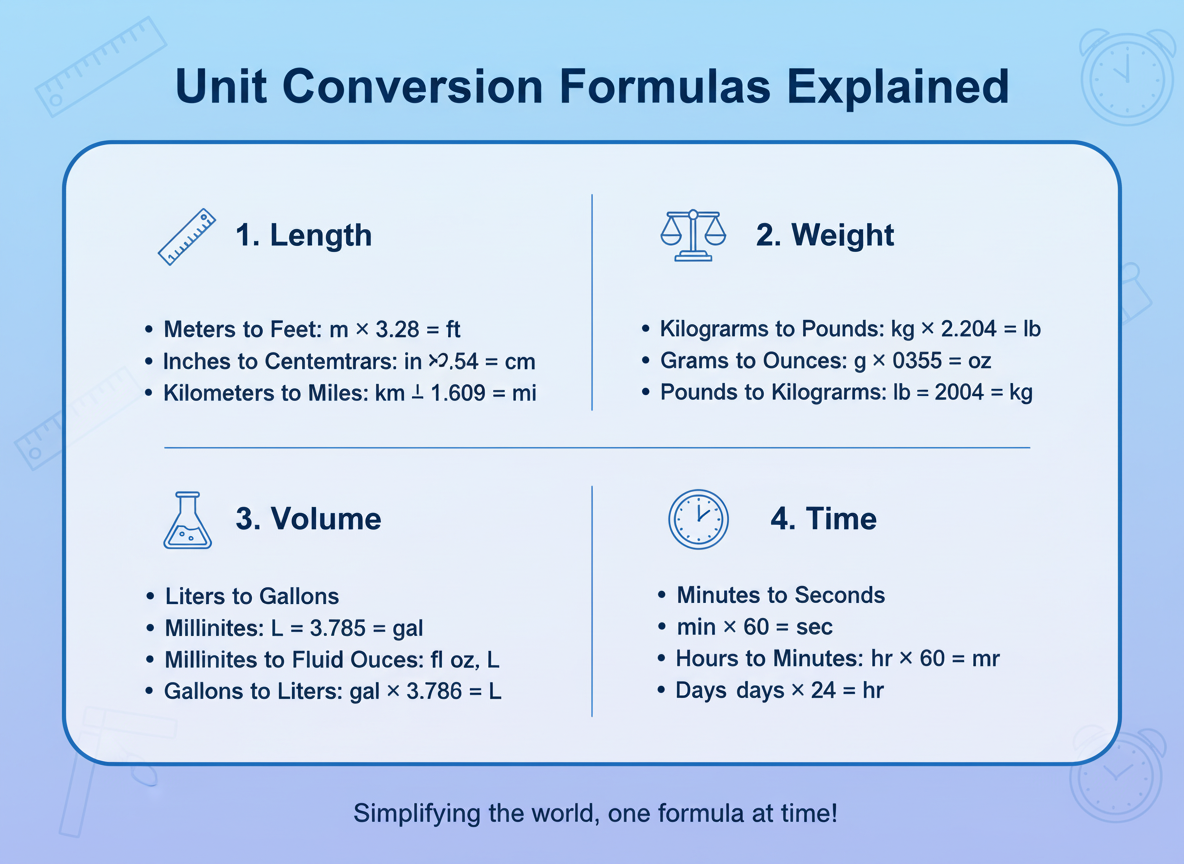
Length Conversion Formulas
Length conversions are among the most common. Here are some key formulas:
- Meters to kilometers: divide by 1000
- Kilometers to miles: multiply by 0.621371
- Feet to meters: multiply by 0.3048
- Inches to centimeters: multiply by 2.54
Example
Convert 5 kilometers to miles:
- 5 × 0.621371 = 3.106855 miles
Mass Conversion Formulas
- Kilograms to grams: multiply by 1000
- Kilograms to pounds: multiply by 2.20462
- Grams to ounces: multiply by 0.035274
Example
Convert 10 kilograms to pounds:
- 10 × 2.20462 = 22.0462 pounds
Volume Conversion Formulas
- Liters to milliliters: multiply by 1000
- Gallons to liters: multiply by 3.78541
- Liters to gallons: multiply by 0.264172
Example
Convert 2 liters to milliliters:
- 2 × 1000 = 2000 mL
Temperature Conversion Formulas
Temperature conversions require special formulas because they are not linear in the same way as other units.
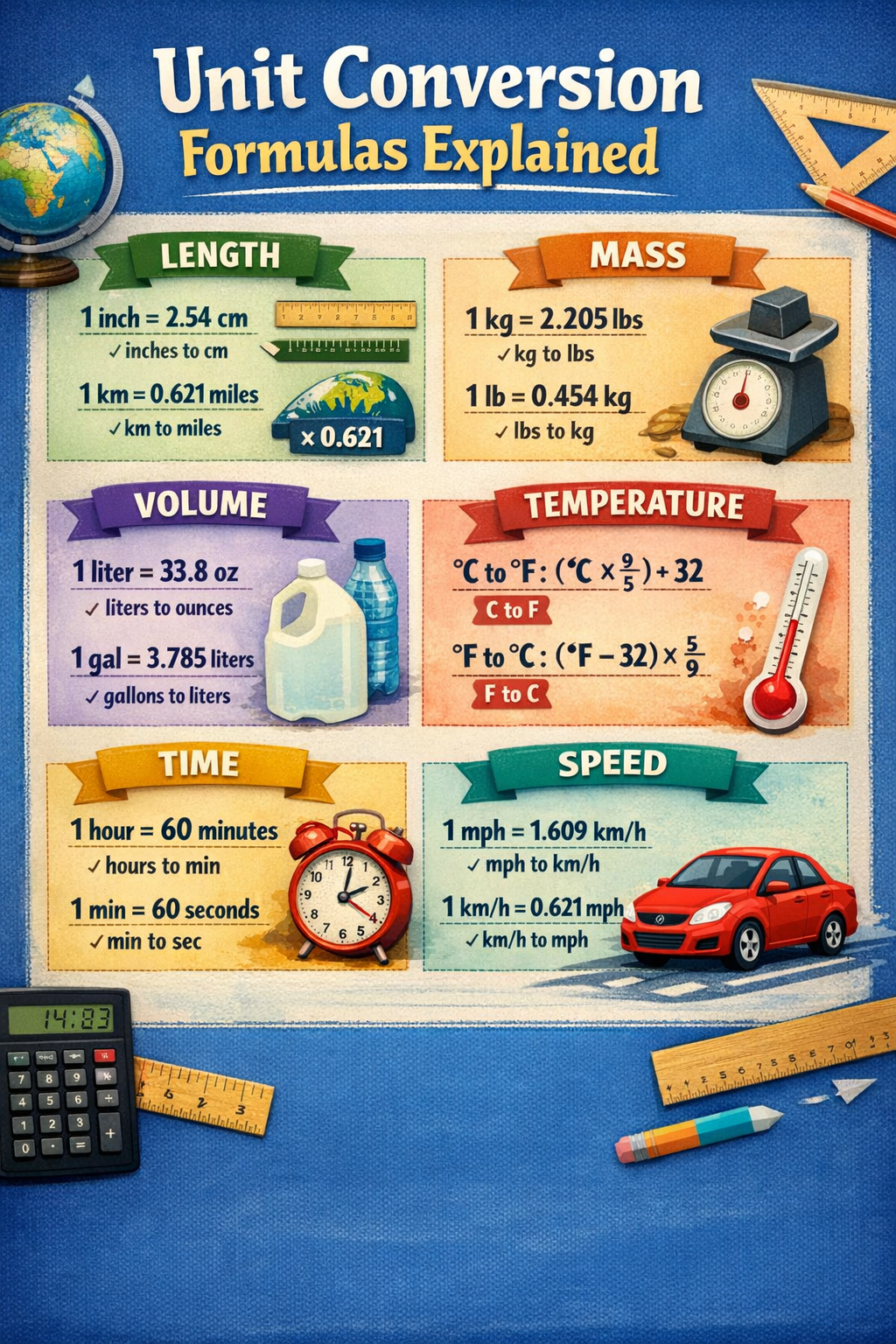
- Celsius to Fahrenheit: (C × 9/5) + 32
- Fahrenheit to Celsius: (F − 32) × 5/9
- Celsius to Kelvin: C + 273.15
Example
Convert 25°C to Fahrenheit:
- (25 × 9/5) + 32 = 77°F
Time Conversion Formulas
- Hours to minutes: multiply by 60
- Minutes to seconds: multiply by 60
- Days to hours: multiply by 24
Example
Convert 3 hours to minutes:
- 3 × 60 = 180 minutes
Area Conversion Formulas
Area conversions require squaring the conversion factor.
- Square meters to square feet: multiply by 10.7639
- Square kilometers to square meters: multiply by 1,000,000
Example
Convert 10 m² to ft²:
- 10 × 10.7639 = 107.639 ft²
Step-by-Step Conversion Method
- Identify the units
- Find the correct conversion factor
- Apply the formula
- Check the result
Common Mistakes in Using Formulas
- Using the wrong factor
- Forgetting to square units
- Incorrect rounding
- Mixing systems
Tips for Mastering Conversion Formulas
- Memorize common conversions
- Practice regularly
- Use tools for verification
Why Understanding Formulas Matters
Knowing formulas improves accuracy and helps you understand how measurements relate to each other.
Real-World Applications
Engineering
Precise measurements ensure safety and efficiency.
Science
Accurate data is essential for experiments.
Everyday Life
Conversions are used in cooking, travel, and more.
Conclusion
Unit conversion formulas are powerful tools that simplify complex calculations. By understanding and applying these formulas correctly, you can ensure accurate results in any situation.
Mastering these formulas not only improves your skills but also builds confidence in handling measurements across different systems.
Most Used Conversions
Frequently Asked Questions
How do you convert Unit Conversion Formulas Explained?
To convert between units, multiply the value by the correct conversion factor. Our calculator automatically applies this formula to give you an instant and accurate result.
What is the formula for Unit Conversion Formulas Explained?
The conversion formula is based on a fixed relationship between the two units. In general, you multiply the input value by a constant factor to get the converted result.
Is this conversion calculator accurate?
Yes. This tool uses standardized conversion formulas and internationally accepted measurement definitions to ensure precise results.
Can I convert decimal values?
Yes. You can enter decimal numbers and the calculator will return highly accurate results instantly.
Why is unit conversion important?
Unit conversion ensures consistency across different measurement systems such as metric and imperial. It is essential in science, engineering, construction, and everyday calculations.
Which measurement systems are supported?
This converter supports both metric (SI units) and imperial systems, allowing accurate conversions across different standards.
Can I use this tool on mobile devices?
Yes. The converter is fully responsive and works on mobile phones, tablets, and desktop devices.
Is this tool free to use?
Yes. The converter is completely free and available for unlimited use without any restrictions.