
Explore Unit Categories
Metric vs Imperial System – Complete Comparison, Differences, Advantages and Real-World Examples
Introduction
Measurement systems are a fundamental part of everyday life. From cooking and construction to science and global trade, accurate measurement ensures consistency, safety, and efficiency. The two most commonly discussed systems are the metric system and the imperial system.
While the metric system is used by most countries worldwide, the imperial system is still used in a few places, most notably the United States. This creates confusion, especially when converting between units or working across international systems.
In this complete guide, we compare the metric vs imperial system in detail, including their history, structure, advantages, disadvantages, and real-world applications. By the end, you will clearly understand why the metric system dominates globally and where the imperial system is still relevant.
What Is the Metric System?
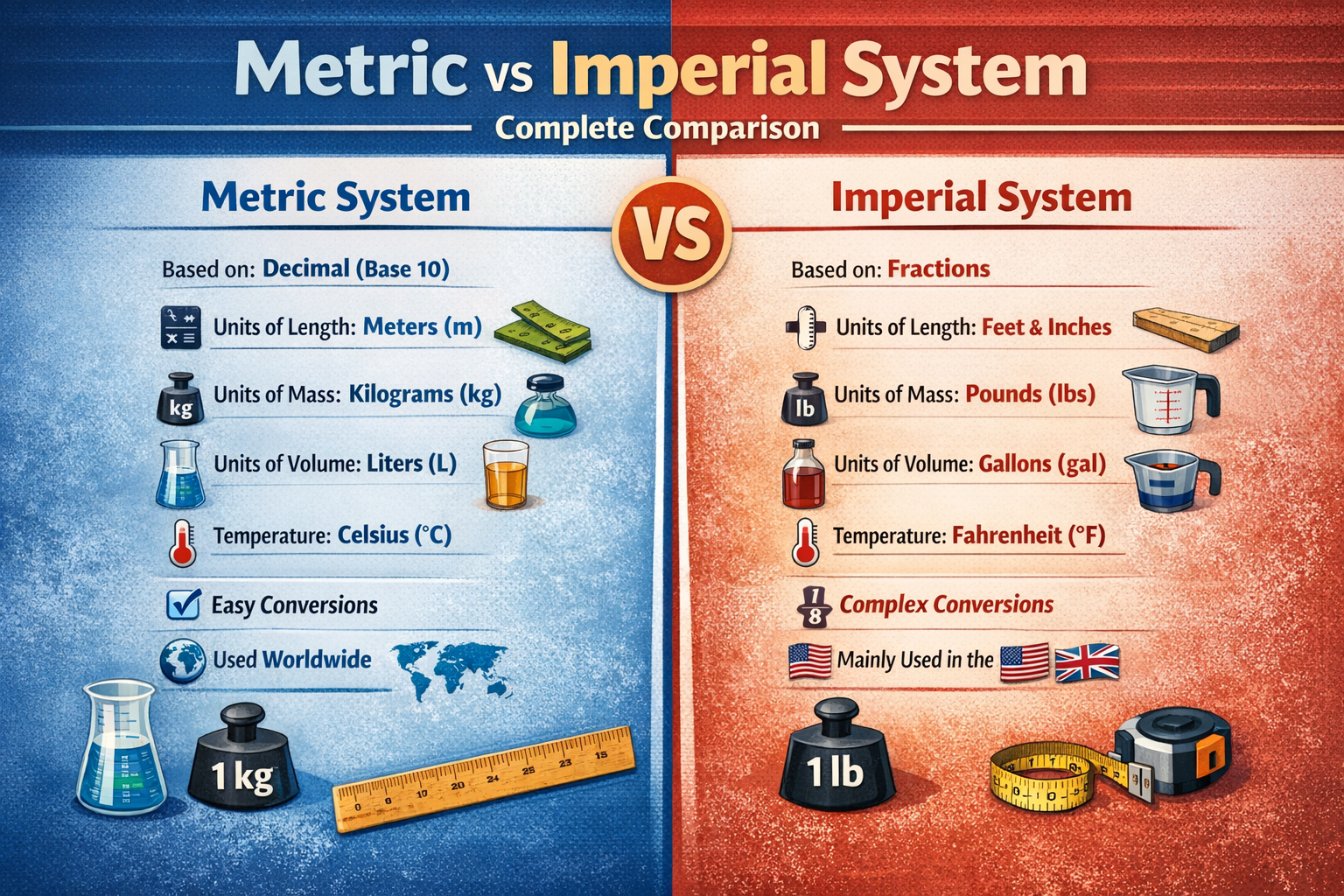
The metric system is a decimal-based system of measurement built on powers of ten. It forms the foundation of the International System of Units (SI), which is the global standard used in science, engineering, and most countries.
The key advantage of the metric system is its simplicity. Units are scaled by factors of 10, making conversions straightforward and intuitive.
Base Units in the Metric System
- Meter (m) – length
- Kilogram (kg) – mass
- Liter (L) – volume
- Second (s) – time
Each unit can be easily converted using prefixes such as milli-, centi-, and kilo-.
What Is the Imperial System?
The imperial system, also known as the British Imperial System, originated in the United Kingdom and is still used in some countries, especially the United States (with slight variations known as the US customary system).
Unlike the metric system, the imperial system does not follow a consistent base. Instead, it uses a variety of conversion factors that must be memorized.
Common Imperial Units
- Inch, foot, yard, mile – length
- Ounce, pound – weight
- Fluid ounce, pint, gallon – volume
Conversions between these units are not uniform, which makes calculations more complex.
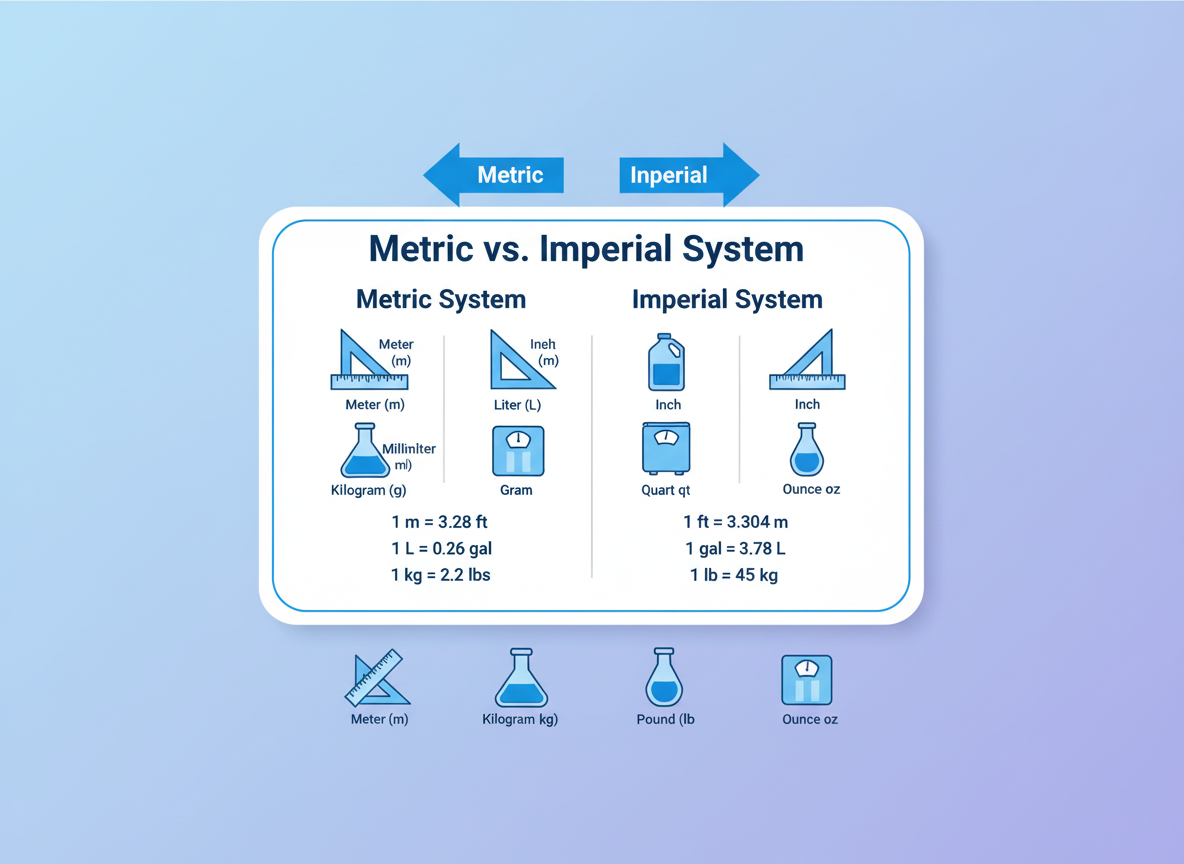
Metric vs Imperial System – Key Differences
Ease of Conversion
One of the biggest advantages of the metric system is how easy it is to convert between units. Because it is based on powers of ten, you only need to move the decimal point.
For example:
- 1 meter = 100 centimeters
- 1 kilometer = 1000 meters
In contrast, imperial conversions require memorization:
- 1 foot = 12 inches
- 1 yard = 3 feet
- 1 mile = 5280 feet
This lack of consistency makes imperial conversions harder to learn and more prone to errors.
Accuracy and Precision
The metric system is designed for accuracy and precision. It is used in scientific research, medicine, and engineering because of its consistency and global standardization.
The imperial system can also be precise, but its complexity increases the likelihood of mistakes, especially in calculations involving multiple conversions.
Global Adoption
The metric system is used by nearly every country in the world. It is the official system of measurement for international trade, science, and education.
The imperial system is mainly used in the United States and partially in the United Kingdom. This creates challenges when working internationally, as conversions are often required.
Real-World Examples
Science and Engineering
Scientists and engineers rely on the metric system because it provides consistency across all disciplines. Units such as meters, kilograms, and seconds are universally understood.
Healthcare
Medical professionals use metric units to measure dosages, weight, and volume. This ensures accuracy and reduces the risk of errors.
Construction
In many countries, construction uses metric measurements for precision and standardization. However, in the United States, imperial units are still common.
Everyday Life
People use measurement systems daily when cooking, driving, or shopping. The metric system simplifies these tasks by providing a consistent structure.
Advantages of the Metric System
- Simple and easy to learn
- Consistent decimal structure
- Globally accepted
- Ideal for science and technology
- Reduces calculation errors
Advantages of the Imperial System
- Familiar in certain regions
- Useful for everyday approximations
- Deep historical roots
Disadvantages of the Metric System
- Less familiar in some countries
- Requires transition from older systems
Disadvantages of the Imperial System
- Complex conversions
- Inconsistent units
- Limited global use
- Higher risk of errors
Why the Metric System Is Better
The metric system is considered better because it is simple, logical, and consistent. Its decimal structure makes it easy to use in both everyday situations and advanced scientific work.
Because it is used worldwide, it also improves communication and collaboration between countries.
Common Conversion Examples
- 1 kilometer = 0.621 miles
- 1 kilogram = 2.204 pounds
- 1 liter = 0.264 gallons
Future of Measurement Systems
As globalization continues, the metric system will remain the dominant system of measurement. Its simplicity and consistency make it the best choice for international use.
While the imperial system may continue to be used in certain regions, the trend clearly favors metric adoption.
Conclusion
The comparison between the metric vs imperial system highlights a clear difference in structure, usability, and global relevance. The metric system offers simplicity, accuracy, and worldwide acceptance, making it the preferred choice for most applications.
Understanding both systems is useful, but adopting the metric system ensures better consistency and efficiency in a connected world.
Most Used Conversions
Frequently Asked Questions
How do you convert Metric vs Imperial System – Complete Comparison?
To convert between units, multiply the value by the correct conversion factor. Our calculator automatically applies this formula to give you an instant and accurate result.
What is the formula for Metric vs Imperial System – Complete Comparison?
The conversion formula is based on a fixed relationship between the two units. In general, you multiply the input value by a constant factor to get the converted result.
Is this conversion calculator accurate?
Yes. This tool uses standardized conversion formulas and internationally accepted measurement definitions to ensure precise results.
Can I convert decimal values?
Yes. You can enter decimal numbers and the calculator will return highly accurate results instantly.
Why is unit conversion important?
Unit conversion ensures consistency across different measurement systems such as metric and imperial. It is essential in science, engineering, construction, and everyday calculations.
Which measurement systems are supported?
This converter supports both metric (SI units) and imperial systems, allowing accurate conversions across different standards.
Can I use this tool on mobile devices?
Yes. The converter is fully responsive and works on mobile phones, tablets, and desktop devices.
Is this tool free to use?
Yes. The converter is completely free and available for unlimited use without any restrictions.