
Loading...
Explore Unit Categories
Liters to Milliliters Conversion – Complete Guide, Formula, Examples and Detailed Tables
Introduction to Liters to Milliliters Conversion
The conversion from liters to milliliters is one of the most fundamental calculations in the metric system. It is widely used in everyday life, science, cooking, healthcare, and industrial processes. Understanding how to convert liters (L) into milliliters (mL) ensures accuracy when measuring liquids and helps avoid costly errors in professional environments.
Because both liters and milliliters belong to the metric system, the conversion between them is straightforward and based on powers of ten. This simplicity makes it one of the easiest conversions to learn and apply in real-world situations.
What Is a Liter?
A liter is a unit of volume in the metric system. It is commonly used to measure liquids such as water, milk, fuel, and beverages. One liter is equal to 1 cubic decimeter (1 dm³), making it a standard unit for volume across many industries.
Liters are used globally and are part of the International System of Units (SI). They are especially common in Europe, Asia, and most parts of the world where the metric system is standard.
What Is a Milliliter?
A milliliter is a smaller unit of volume in the metric system. It represents one-thousandth of a liter. Milliliters are typically used when measuring small quantities of liquid, such as medication, cooking ingredients, or laboratory samples.
Because milliliters provide greater precision, they are widely used in medical and scientific applications where accuracy is critical.
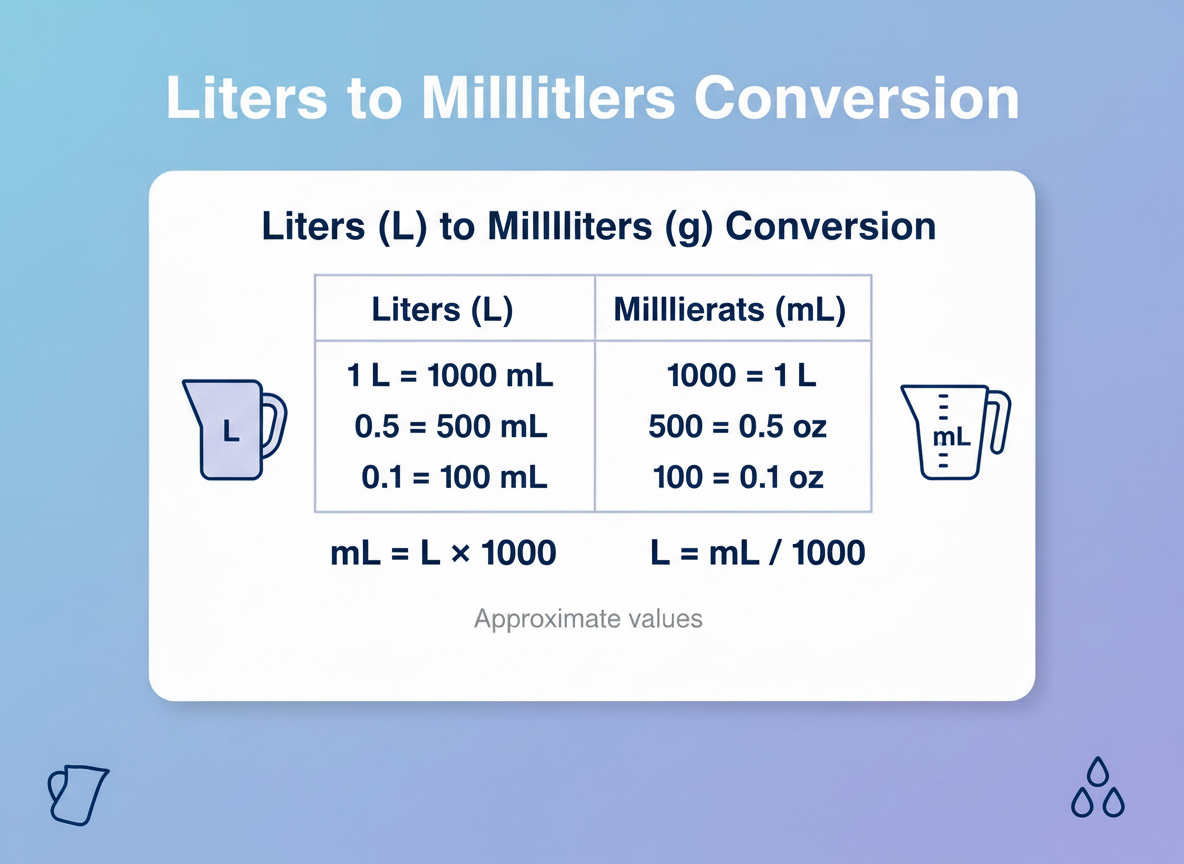
Liters to Milliliters Conversion Formula
Milliliters = Liters × 1000
This formula works because “milli” means one-thousandth. Therefore, one liter contains exactly 1000 milliliters.
Step-by-Step Conversion Examples
Example 1: Convert 1 Liter
- 1 × 1000 = 1000 mL
- Result: 1 L = 1000 mL
Example 2: Convert 2.5 Liters
- 2.5 × 1000 = 2500 mL
- Result: 2.5 L = 2500 mL
Example 3: Convert 0.75 Liters
- 0.75 × 1000 = 750 mL
- Result: 0.75 L = 750 mL
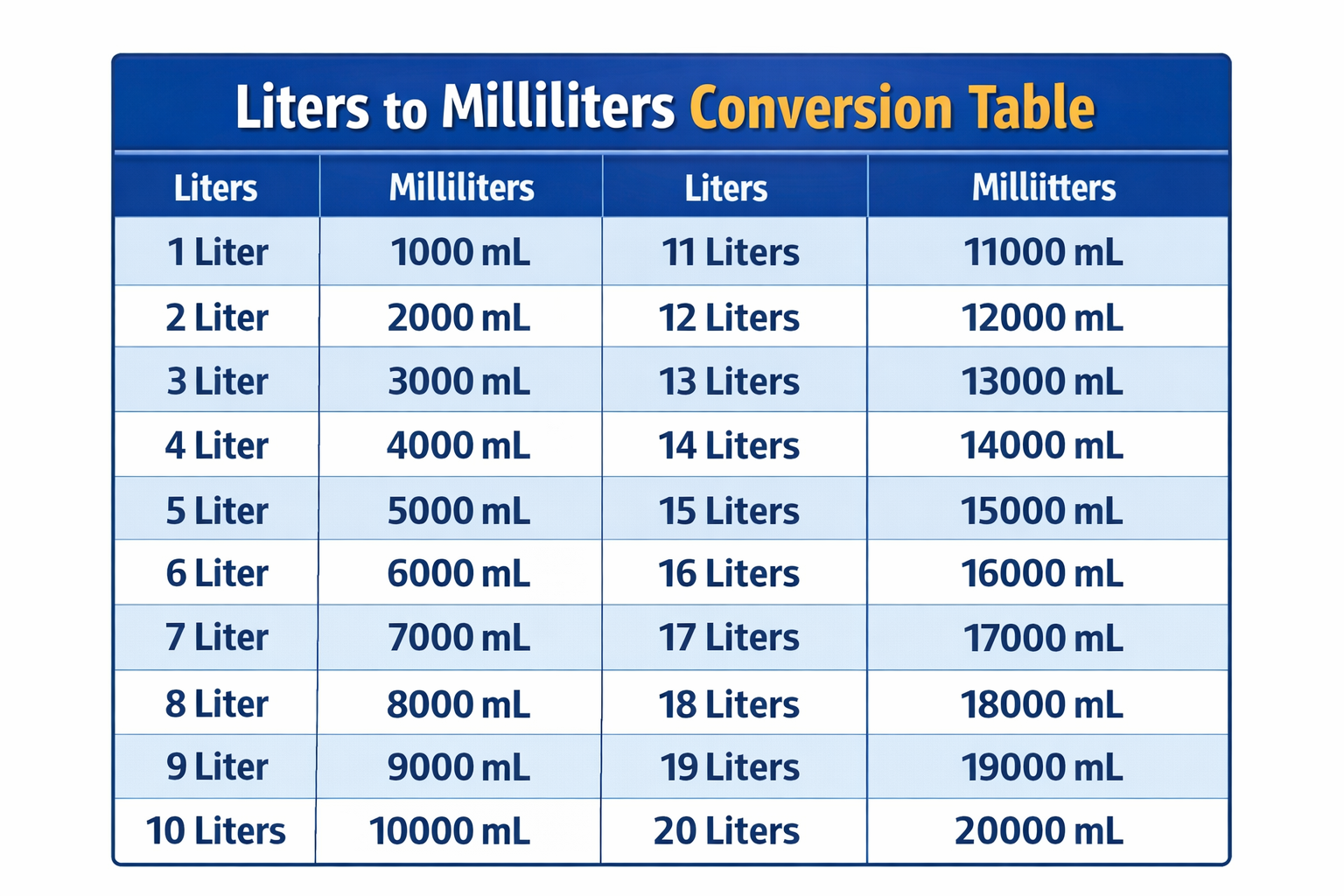
Liters to Milliliters Conversion Table
Why This Conversion Is Important
Accurate volume measurement is critical in many fields. A small mistake in conversion can lead to incorrect results, especially in industries like healthcare and chemistry. Understanding how to convert liters to milliliters ensures consistency and precision.
Real-World Applications
Cooking and Recipes
Recipes often require precise measurements. Converting liters to milliliters allows for accurate ingredient quantities, especially when scaling recipes.
Medical and Healthcare Use
Doctors and pharmacists use milliliters to measure medication dosages. Accuracy is crucial to ensure patient safety.
Science and Laboratory Work
Experiments require precise liquid measurements. Milliliters provide the level of detail needed for scientific accuracy.
Industrial and Manufacturing
Factories and production lines use volume conversions to maintain consistency in products.
Quick Mental Conversion Tips
Converting liters to milliliters is extremely simple:
- Multiply by 1000
- Move the decimal point 3 places to the right
Example:
- 3.5 L → 3500 mL
Metric System Advantages
The metric system is based on powers of ten, making conversions straightforward and consistent. Unlike imperial units, which use irregular conversion factors, metric conversions are simple and easy to remember.
Common Mistakes to Avoid
- Forgetting to multiply by 1000
- Incorrect decimal placement
- Mixing up units (L vs mL)
Conversion in Everyday Life
From measuring water intake to fueling vehicles, liters and milliliters are used constantly. Understanding their relationship improves accuracy and efficiency in daily tasks.
Advanced Applications
In scientific research, even slight measurement errors can affect results. Using milliliters ensures higher precision, especially in chemical reactions and biological studies.
Conclusion
Liters to milliliters conversion is one of the simplest and most important calculations in the metric system. With a clear formula and easy mental math, anyone can quickly convert between these units. Whether in the kitchen, laboratory, or workplace, mastering this conversion ensures accuracy and reliability.
Most Used Conversions
Frequently Asked Questions
How do you convert Liters to Milliliters Conversion?
To convert between units, multiply the value by the correct conversion factor. Our calculator automatically applies this formula to give you an instant and accurate result.
What is the formula for Liters to Milliliters Conversion?
The conversion formula is based on a fixed relationship between the two units. In general, you multiply the input value by a constant factor to get the converted result.
Is this conversion calculator accurate?
Yes. This tool uses standardized conversion formulas and internationally accepted measurement definitions to ensure precise results.
Can I convert decimal values?
Yes. You can enter decimal numbers and the calculator will return highly accurate results instantly.
Why is unit conversion important?
Unit conversion ensures consistency across different measurement systems such as metric and imperial. It is essential in science, engineering, construction, and everyday calculations.
Which measurement systems are supported?
This converter supports both metric (SI units) and imperial systems, allowing accurate conversions across different standards.
Can I use this tool on mobile devices?
Yes. The converter is fully responsive and works on mobile phones, tablets, and desktop devices.
Is this tool free to use?
Yes. The converter is completely free and available for unlimited use without any restrictions.