
Explore Unit Categories
How Unit Conversions Are Used in Real Life – Practical Examples, Industries and Everyday Applications Explained
Introduction
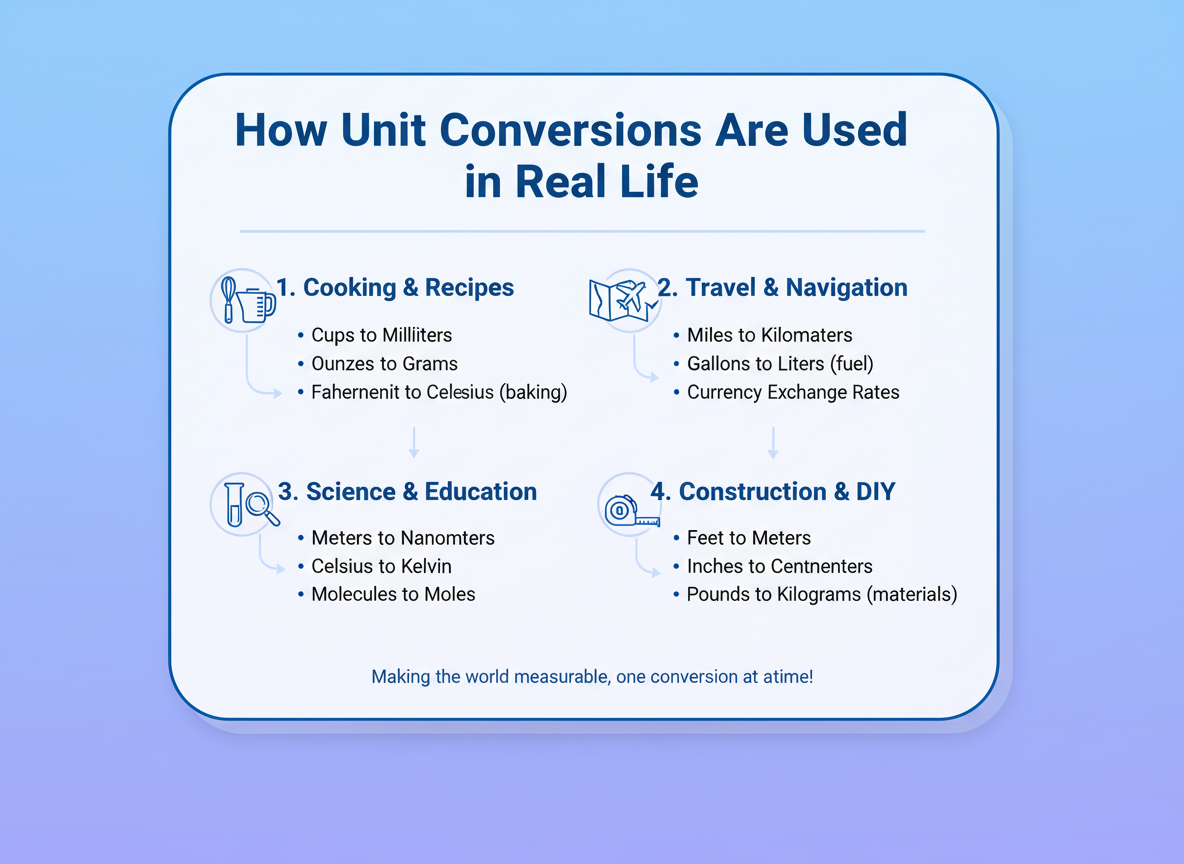
Unit conversion is not just a mathematical concept taught in school — it is a practical skill used every single day in real life. From cooking meals and driving cars to building houses and conducting scientific research, unit conversions play a critical role in ensuring accuracy, consistency, and efficiency.
Understanding how unit conversions are used in real-world situations helps you see their importance beyond theory. This guide explores how conversions apply across various industries and daily activities, providing practical examples and insights.
What Is Unit Conversion?
Unit conversion is the process of changing a measurement from one unit to another without altering the value it represents. For example, converting kilometers to miles or liters to milliliters allows measurements to be understood across different systems.
This process is essential in a globalized world where multiple measurement systems are used.
Why Unit Conversion Is Important in Everyday Life
- Ensures accurate measurements
- Allows communication between different systems
- Prevents errors in calculations
- Improves efficiency in tasks
Unit Conversions in Daily Activities
Cooking and Baking
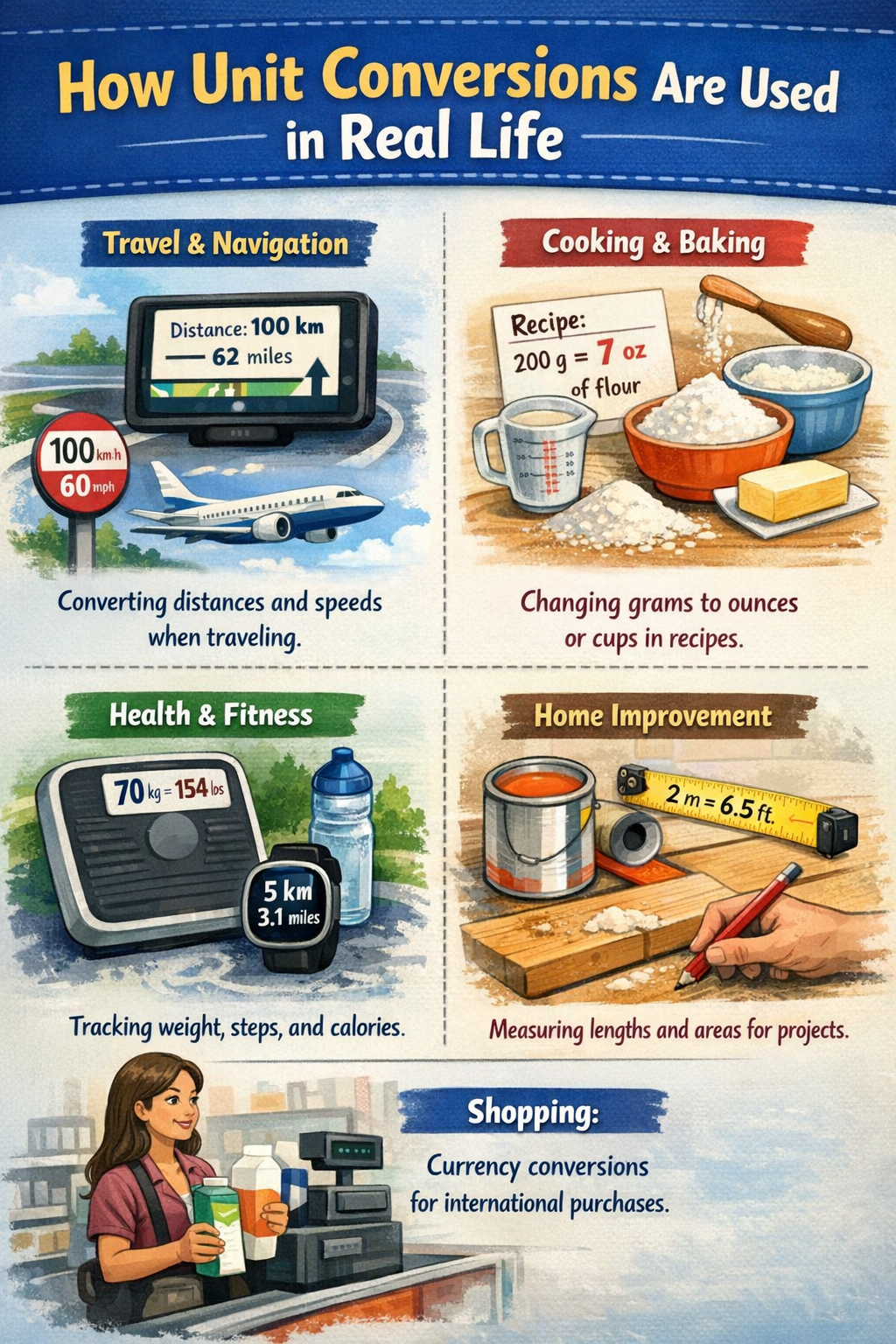
One of the most common uses of unit conversion is in the kitchen. Recipes may use different units depending on the country or source.
Example:
- 1 liter = 1000 milliliters
- 1 cup ≈ 240 milliliters
Accurate conversion ensures the correct taste and texture of food.
Driving and Travel
Distances and speeds are measured differently across countries. For example, speed limits may be in kilometers per hour (km/h) or miles per hour (mph).
Example:
- 100 km/h ≈ 62 mph
Shopping and Pricing
Products may be sold in different units. Converting between grams, kilograms, pounds, or liters helps compare prices and quantities effectively.
Unit Conversion in Professional Fields
Engineering and Construction
Accurate measurements are critical in construction. Converting between metric and imperial units ensures that materials fit correctly and structures remain safe.
Healthcare and Medicine
Medical professionals rely on precise conversions for dosages and measurements. Even small errors can have serious consequences.
Science and Research
Experiments require exact measurements, often involving multiple unit conversions.
Manufacturing and Industry
Production processes depend on consistent measurements. Unit conversion ensures uniformity in products.
Common Challenges in Real-Life Conversions
- Different measurement systems
- Incorrect conversion factors
- Rounding errors
- Unit confusion
Tips for Accurate Conversion in Real Life
- Always check units carefully
- Use reliable conversion tools
- Practice common conversions
- Avoid rounding too early
Why Conversion Skills Are Essential
Being able to convert units quickly and accurately is a valuable skill. It improves efficiency and reduces errors in both personal and professional tasks.
Impact of Globalization
As the world becomes more connected, the need for unit conversion increases. International trade, travel, and communication all depend on accurate conversions.
Advanced Real-Life Applications
Technology
Software and devices often perform automatic conversions to provide accurate data.
Energy and Fuel
Fuel consumption and energy usage involve multiple unit conversions.
Environmental Science
Measurements such as emissions and resource usage require precise conversion.
Why Accuracy Matters
Inaccurate conversions can lead to errors, inefficiency, and even safety risks. Ensuring accuracy is essential in all applications.
Conclusion
Unit conversion is a vital skill used in everyday life and across many industries. By understanding how conversions work and applying them correctly, you can improve accuracy and efficiency in any situation.
Whether you are cooking, traveling, working, or studying, mastering unit conversion will make tasks easier and more reliable.
Most Used Conversions
Frequently Asked Questions
How do you convert How Unit Conversions Are Used in Real Life?
To convert between units, multiply the value by the correct conversion factor. Our calculator automatically applies this formula to give you an instant and accurate result.
What is the formula for How Unit Conversions Are Used in Real Life?
The conversion formula is based on a fixed relationship between the two units. In general, you multiply the input value by a constant factor to get the converted result.
Is this conversion calculator accurate?
Yes. This tool uses standardized conversion formulas and internationally accepted measurement definitions to ensure precise results.
Can I convert decimal values?
Yes. You can enter decimal numbers and the calculator will return highly accurate results instantly.
Why is unit conversion important?
Unit conversion ensures consistency across different measurement systems such as metric and imperial. It is essential in science, engineering, construction, and everyday calculations.
Which measurement systems are supported?
This converter supports both metric (SI units) and imperial systems, allowing accurate conversions across different standards.
Can I use this tool on mobile devices?
Yes. The converter is fully responsive and works on mobile phones, tablets, and desktop devices.
Is this tool free to use?
Yes. The converter is completely free and available for unlimited use without any restrictions.