
Area Unit Converter

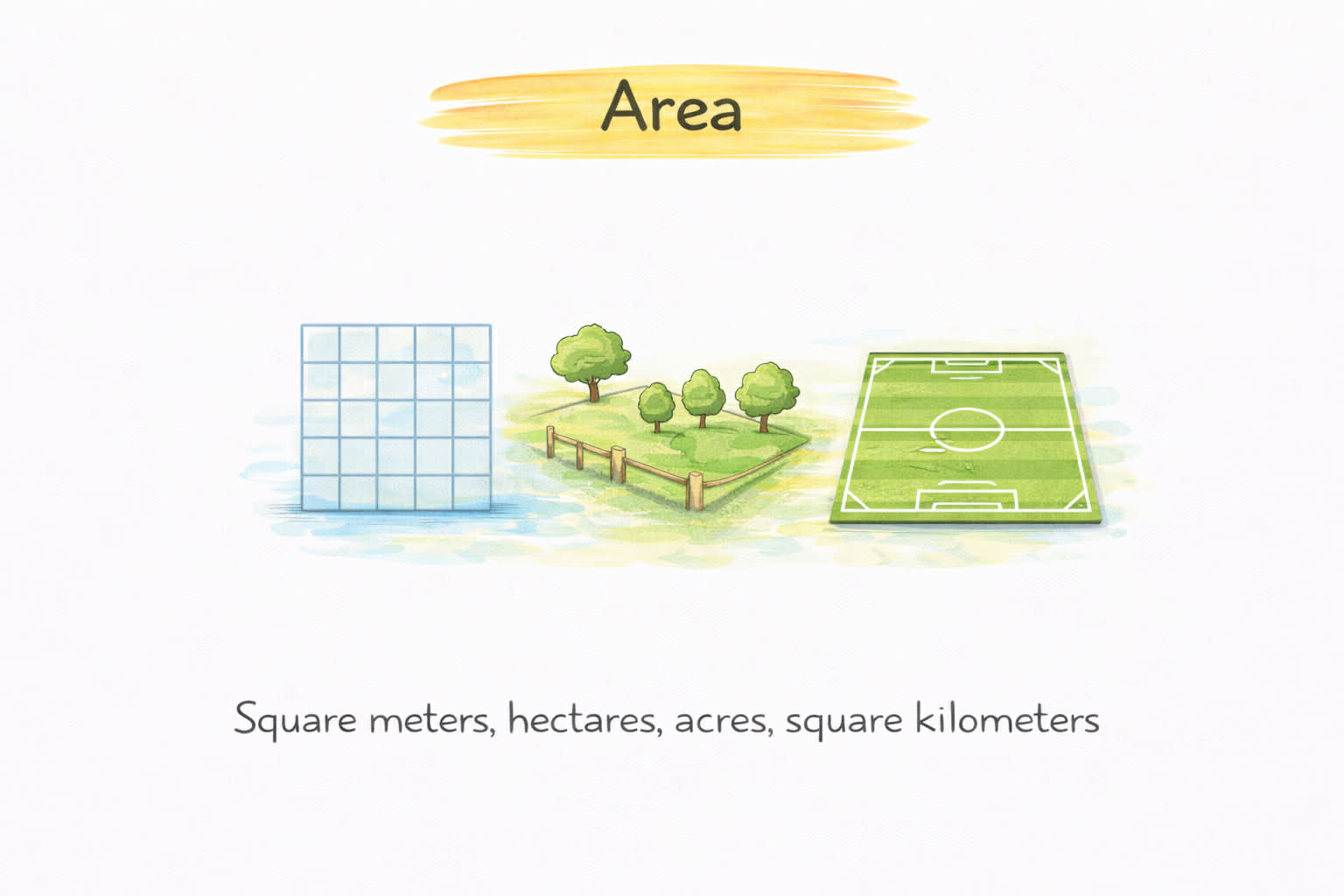
Convert area units such as square meters, hectares, acres, and square kilometers. Useful for land measurement, real estate, agriculture, and construction projects.

What is Acres to Square Feet Conversion?

Acres to square feet conversion is the process of converting land area from acres (AC) into square feet (FT²) while preserving the same physical space.
An acre is a commonly used unit for measuring large land areas, especially in real estate, agriculture, and land development, while square feet is more detailed and often used for smaller spaces.

This type of conversion is essential when translating large land measurements into more precise units.
For example, property listings may use acres, while building plans and layouts require square feet for accuracy and detail.

Understanding how acres convert into square feet allows for better planning, accurate comparisons, and consistent communication across different industries and regions.

Why Convert Acres to Square Feet?

Converting acres to square feet is important because it provides a clearer and more detailed understanding of land size.
While acres are ideal for large-scale measurements, square feet offer precision for planning and calculations.

  • Real Estate: Property sizes are often converted to square feet for detailed listings
  • Construction: Builders use square feet to plan structures and materials
  • Land Development: Accurate area calculations are required for zoning and design
  • Interior Planning: Square feet helps determine usable space within a property
  • Cost Estimation: Pricing is often calculated per square foot

By converting acres into square feet, users gain a more practical and usable measurement for real-world applications.

How Acres to Square Feet Conversion Works

Acres to square feet conversion is based on a fixed mathematical relationship between the two units.
One acre is equal to 43,560 square feet, making it a straightforward multiplication process.

To convert acres to square feet, simply multiply the number of acres by 43,560:

  • 1 acre = 43,560 square feet
  • 2 acres = 87,120 square feet
  • 5 acres = 217,800 square feet

This consistent relationship ensures accurate and reliable conversions across all applications.

Understanding Acres and Square Feet

🌿 Acres (AC)

A unit commonly used to measure large areas of land.

  • 1 acre = 43,560 square feet
  • Used in real estate and agriculture
  • Ideal for large land measurements

📏 Square Feet (FT²)

A detailed unit used for measuring smaller spaces.

  • 1 ft² = area of a square with 1 ft sides
  • Used in construction and interior design
  • Provides precise measurements

While acres provide a broad overview of land size, square feet offer the level of detail needed for planning and development.

Common Acres to Square Feet Conversions

Here are some commonly used conversion values:

  • 1 acre = 43,560 ft²
  • 0.5 acre = 21,780 ft²
  • 2 acres = 87,120 ft²
  • 10 acres = 435,600 ft²
  • 50 acres = 2,178,000 ft²
  • 100 acres = 4,356,000 ft²

These values are frequently used in land measurement, property evaluation, and planning projects.

Real-Life Examples of Acres to Square Feet

Understanding practical examples makes this conversion easier to visualize.

  • A standard football field (without end zones) is about 1.32 acres or ~57,500 ft²
  • A typical residential lot may be around 0.25 acres or 10,890 ft²
  • A large farm may span 100 acres or over 4 million square feet
  • A commercial property might cover 2 acres or 87,120 ft²

These examples highlight how converting acres into square feet provides a clearer sense of scale.

Where This Conversion is Used

Acres to square feet conversion is widely used across multiple industries where accurate land measurement is essential.

  • Real Estate: Property listings and valuation
  • Construction: Building layout and material planning
  • Agriculture: Land usage and crop planning
  • Urban Planning: Infrastructure and zoning
  • Surveying: Accurate land measurement and mapping

In these fields, converting between units ensures accuracy and consistency.

Benefits of Using an Acres to Square Feet Converter

Using an online converter makes the process quick and error-free.

  • Instant and precise results
  • No manual calculations required
  • Supports large and small values
  • Accessible on any device

This allows both professionals and everyday users to perform conversions efficiently.

Tips for Accurate Conversion

  • Always use the correct conversion factor (43,560)
  • Double-check units before converting
  • Avoid rounding too early
  • Use reliable tools for precision

Following these tips ensures accurate and consistent results.

Conclusion

Converting acres to square feet is essential for understanding land size in greater detail.
Whether you’re working in real estate, construction, or agriculture, accurate conversions help ensure proper planning and decision-making.

By using the standard conversion factor and reliable tools, you can quickly and confidently convert acres into square feet for any application.

This converter provides a fast, accurate, and user-friendly way to perform acreage conversions anytime you need them.
Dynamic Area Converter

= 0

Sources & Standards

  • International System of Units (SI)
  • National Institute of Standards and Technology (NIST)
  • ISO Measurement Standards

All conversion values on this page are based on globally accepted measurement standards.

💡 Did you know?

Conversion Table (1-10)

Visual Conversion Diagram

1 0

Understanding Area Units in Detail

Area is a fundamental physical quantity used across science, engineering, and everyday life. It is measured using different unit systems depending on the region, industry, and application.

The metric system provides a standardized and scalable approach based on powers of ten, while other systems such as the imperial system use different relationships between units. This is why reliable conversion tools are essential for accurate calculations and global communication.

Popular Area Conversions

Below are some of the most frequently used area conversions used in science, engineering, travel, and everyday measurements.

Why Conversion Accuracy Matters

In engineering and aviation, even small conversion errors can lead to serious consequences. For example, incorrect unit conversion has historically caused system failures and costly mistakes.

Area Conversions (m², km², acres & more)

Browse all available area conversion tools below. Each converter provides accurate calculations based on internationally recognized measurement standards.

Area Conversion Explained

Area conversion is the process of translating a measurement from one unit into another unit that represents the same quantity. Different industries and countries often use different measurement systems, which makes reliable conversion tools essential for accurate calculations.

The calculator on this page allows you to convert between commonly used area units instantly. By entering a value and selecting the desired units, the tool automatically applies standardized mathematical formulas to generate precise results.

Whether you are working with metric measurements or imperial units, accurate unit conversions help ensure consistency across engineering, science, education, and everyday applications.

area

💡 Real-life facts

    Related Unit Conversion Tools

    Discover related unit conversion tools across different categories.

    Frequently Asked Questions

    Find answers to common questions about area conversions, formulas, accuracy, and measurement systems.

    Area unit conversion is the process of converting a measurement from one unit into another while maintaining the same value. This is commonly used when working between different systems such as the metric system and the imperial system. Using accurate conversion formulas ensures consistency in scientific calculations, engineering work, and everyday tasks.

    Area conversion works by applying a conversion factor that defines the relationship between two units. For example, one unit is multiplied or divided by a constant value to obtain the equivalent measurement in another unit. Modern online converters automate this process to provide instant and highly accurate results.

    Area conversion is essential in many industries including engineering, science, travel, construction, and education. Different countries use different measurement systems, so converting units ensures accurate communication and prevents costly errors in calculations.

    A conversion factor is a numerical value that expresses how one unit relates to another. For example, in many Area conversions, one unit can be converted by multiplying by a fixed constant. These factors are standardized and based on internationally accepted measurement systems.

    Area measurements are typically based on two main systems: the metric system and the imperial system. The metric system is used globally and is based on powers of ten, while the imperial system is still used in certain countries and industries. This converter supports both systems for seamless conversion.

    Yes, this Area converter uses internationally recognized formulas and precise conversion constants. All calculations are performed using accurate values to ensure reliable results suitable for both professional and everyday use.

    Yes, this tool supports decimal values, allowing precise Area conversions for both small and large measurements. This is especially important in scientific and engineering applications where accuracy is critical.

    The most common Area conversions depend on the category. For example, users often convert between popular units used in daily life, industry, and international standards. This page provides quick access to the most frequently used conversion combinations.

    The fastest way to convert Area units is by using an online converter like this one. Simply enter a value, select your units, and the result is calculated instantly. This eliminates manual calculations and reduces the risk of errors.

    Yes, Area conversion formulas are based on internationally accepted standards such as the SI (International System of Units). These standards ensure that conversions are consistent, accurate, and universally recognized across different fields and industries.

    Reviewed by measurement specialists. All conversion formulas follow internationally recognized standards including SI (International System of Units) and NIST guidelines.