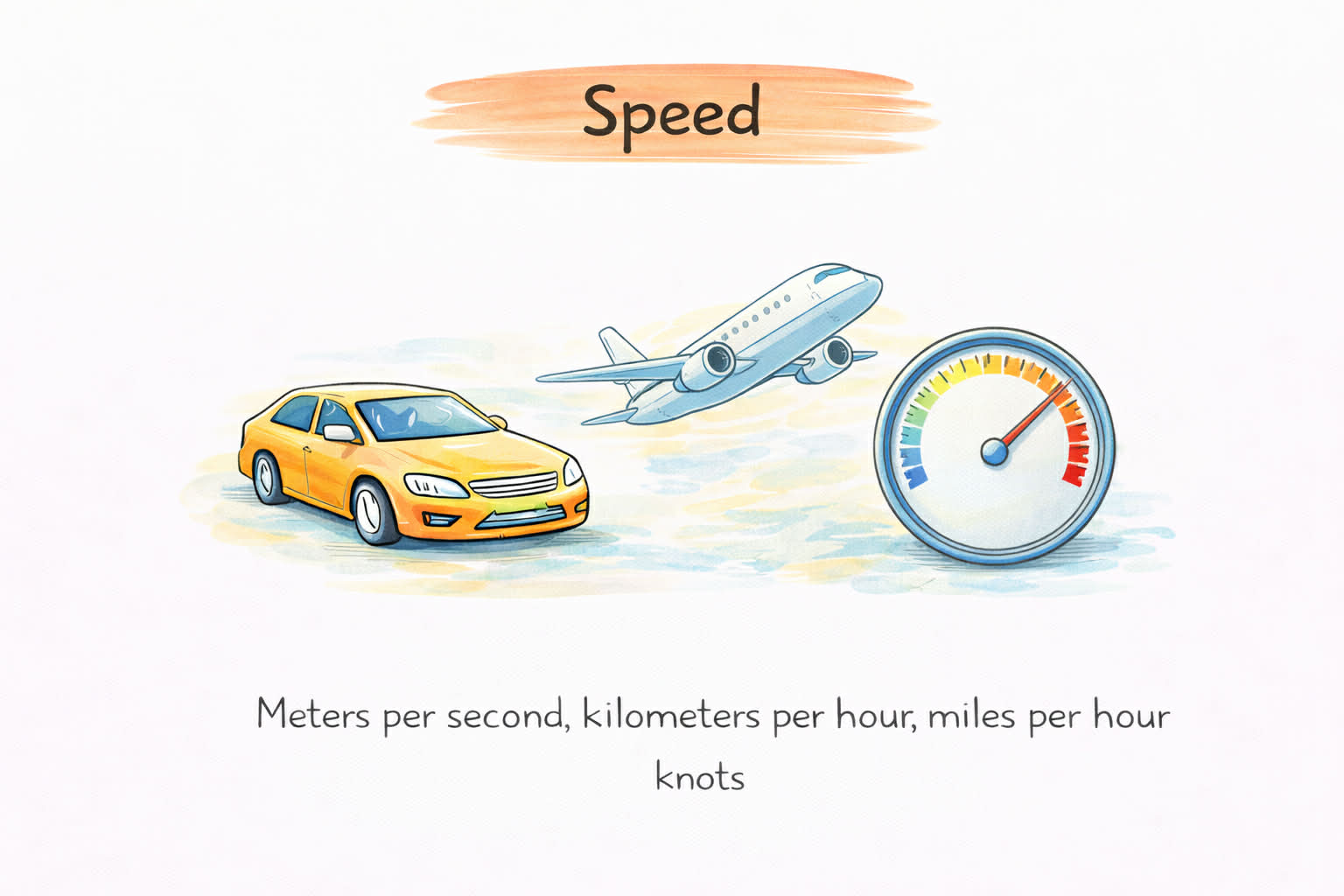
What is Speed Conversion?
Speed conversion is the process of converting a measurement of speed from one unit into another while maintaining the same rate of motion.
Speed describes how fast an object moves over a given distance within a specific time.
It is one of the most commonly used measurements in everyday life, from driving and travel to science, engineering, and sports.
Different countries and industries use different units such as kilometers per hour (km/h), miles per hour (mph), and meters per second (m/s).
Speed conversion allows these different systems to communicate accurately, ensuring consistency across global applications.
Why Speed Conversion is Important
Speed conversion plays a vital role in daily activities and professional fields where movement and timing are critical.
- Driving: Speed limits vary between km/h and mph depending on the country
- Aviation: Aircraft speeds are measured in knots and require precise conversion
- Sports: Performance metrics depend on accurate speed calculations
- Engineering: Systems must operate within safe speed limits
- Science: Experiments rely on consistent units of motion
Without proper conversion, interpreting speed data could lead to confusion or dangerous errors.
How Speed Conversion Works
Speed is calculated using the relationship between distance and time.
All speed conversions are based on converting both distance and time units.
For example:
- 1 km/h = 0.277778 m/s
- 1 mph = 0.44704 m/s
- 1 knot = 0.514444 m/s
To convert between units, values are multiplied by a conversion factor that relates the units.
For instance, converting km/h to mph involves multiplying by approximately 0.621371.
This method ensures accurate and standardized results across all systems.
Common Speed Units Explained
Different units of speed are used depending on the context and industry.
🚗 Road & Everyday Use
- Kilometers per hour (km/h)
- Miles per hour (mph)
✈️ Scientific & Specialized
- Meters per second (m/s)
- Knots (nautical miles per hour)
Each unit serves a specific purpose depending on the level of precision and industry requirements.
Common Speed Conversions
Here are some of the most frequently used speed conversions:
- 1 km/h = 0.621371 mph
- 1 mph = 1.60934 km/h
- 1 m/s = 3.6 km/h
- 1 knot = 1.852 km/h
- 1 km/h = 0.277778 m/s
- 1 mph = 0.44704 m/s
These standardized values are used worldwide in transportation, science, and engineering.
Real-Life Examples of Speed Conversion
Understanding real-world applications helps make speed conversion easier to grasp.
- A car traveling at 100 km/h is about 62 mph
- A runner moving at 5 m/s equals 18 km/h
- An airplane flying at 500 knots equals about 926 km/h
- A cyclist at 20 mph travels approximately 32 km/h
These examples show how speed conversion helps translate motion into familiar units.
Speed Conversion in Different Industries
Accurate speed conversion is critical across many industries where movement and timing are essential.
- Transportation: Vehicles operate under strict speed regulations
- Aviation: Flight speeds are calculated in knots
- Engineering: Machines must run within safe speed ranges
- Sports: Performance tracking depends on speed metrics
- Physics: Motion and velocity calculations require precise units
Even small conversion errors can significantly impact performance and safety.
Advantages of Using an Online Speed Converter
Online speed converters provide quick and accurate calculations without manual effort.
- Instant results
- Supports multiple units
- Eliminates calculation errors
- Easy to use on any device
These tools are ideal for both everyday users and professionals.
Tips for Accurate Speed Conversion
- Always verify both distance and time units
- Use standardized conversion values
- Avoid rounding too early
- Use reliable tools for complex calculations
Following these tips ensures accurate and reliable speed conversions.
Conclusion
Speed conversion is an essential part of modern life, from driving and travel to science and engineering.
Accurate speed measurements ensure safety, efficiency, and consistency across all industries.
By understanding how speed units relate and using reliable conversion tools, you can easily convert between units and work confidently with motion data.
This page provides both the knowledge and tools needed to perform accurate speed conversions quickly and efficiently.