
Explore Unit Categories
Common Unit Conversion Mistakes and How to Avoid Them – Complete Guide with Examples and Expert Tips
Introduction
Unit conversion is a fundamental part of everyday life, science, engineering, and business. Whether you are converting kilometers to miles, kilograms to pounds, or liters to milliliters, accuracy is essential. However, many people make common mistakes when converting units, which can lead to incorrect results, costly errors, and confusion.
This comprehensive guide explores the most common unit conversion mistakes, explains why they happen, and provides practical solutions to avoid them. By understanding these pitfalls, you can improve accuracy, save time, and confidently perform conversions in any situation.
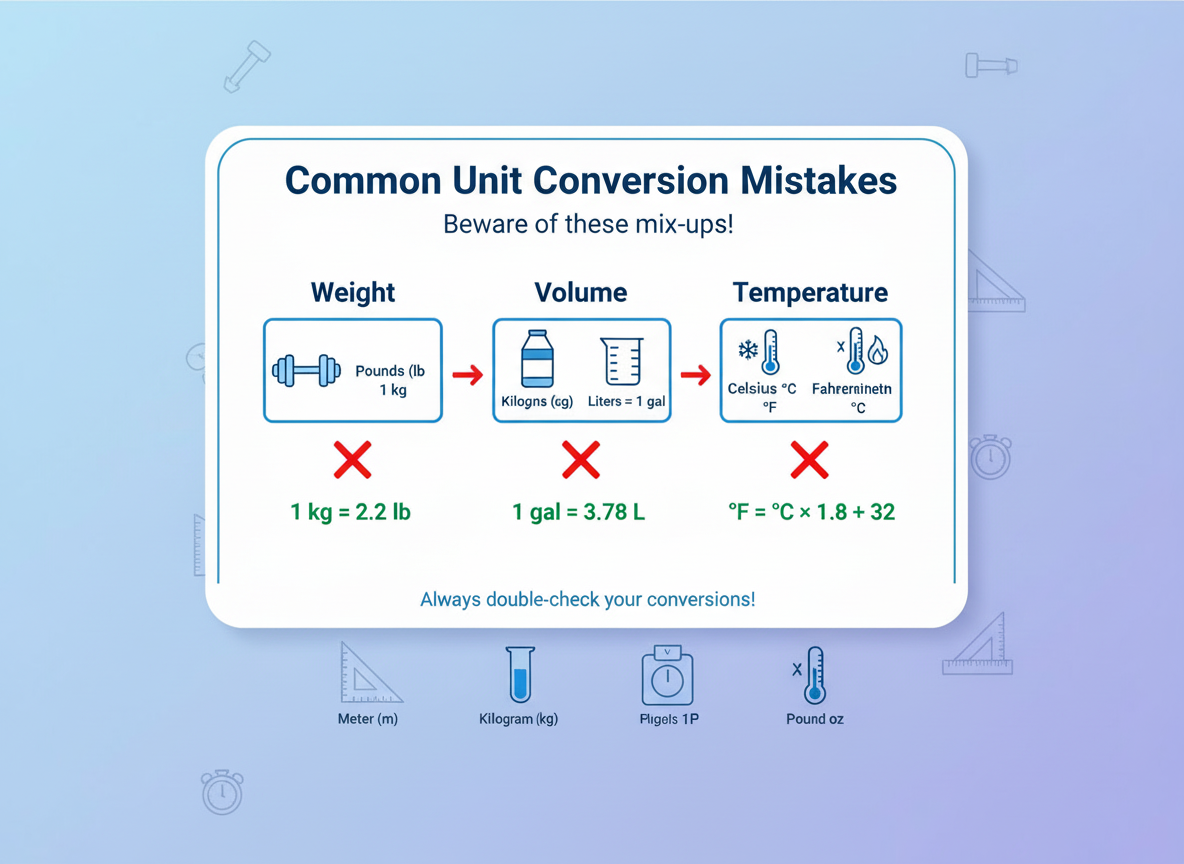
Why Unit Conversion Errors Matter
At first glance, a small conversion error might seem insignificant. However, in many real-world scenarios, even minor mistakes can have serious consequences.
- In engineering, incorrect measurements can cause structural failures
- In healthcare, dosage errors can impact patient safety
- In cooking, wrong measurements can ruin recipes
- In business, miscalculations can lead to financial loss
Most Common Unit Conversion Mistakes
1. Using the Wrong Conversion Factor
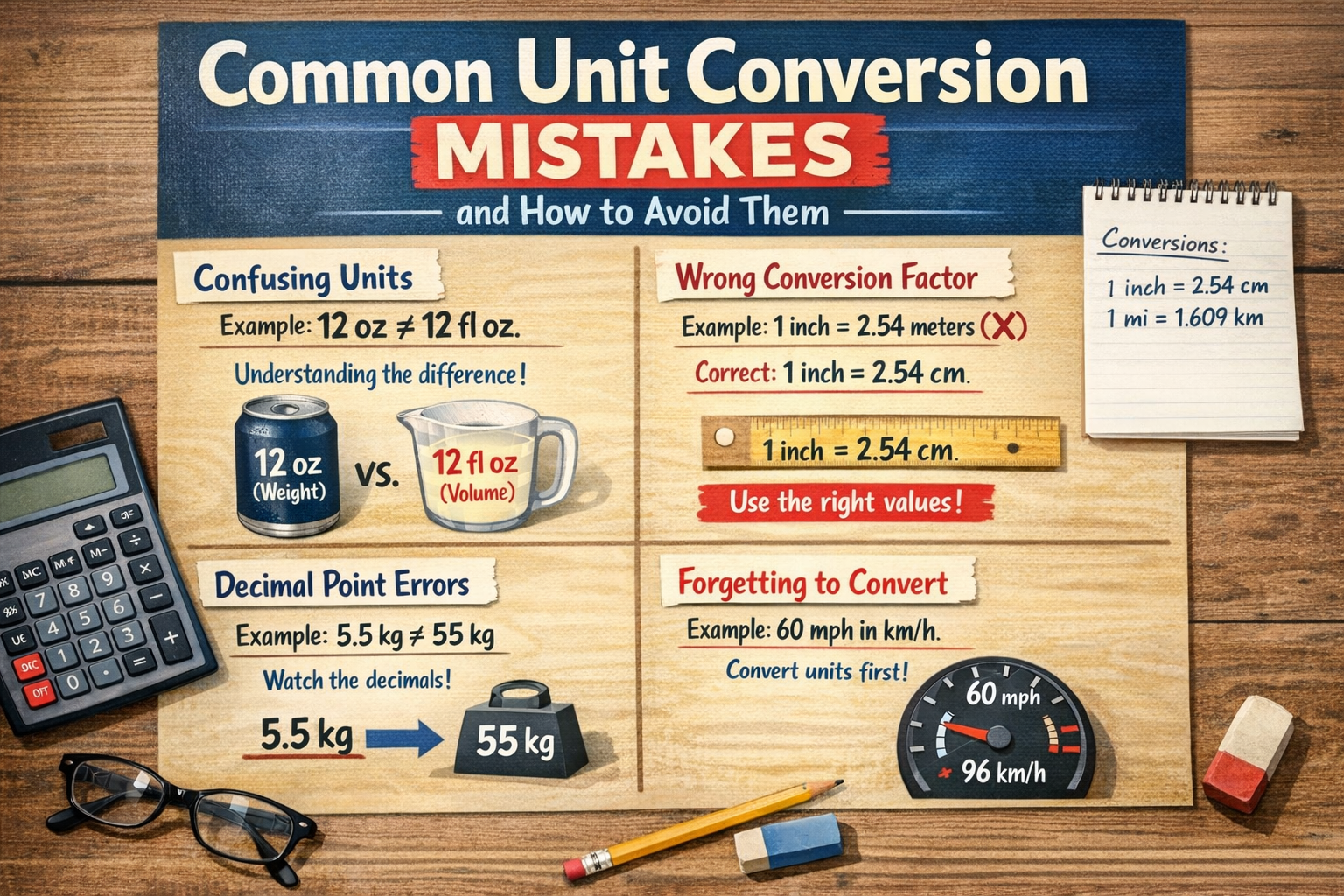
One of the most common mistakes is applying an incorrect conversion factor.
- 1 km = 0.621 miles
- 1 mile = 1.609 km
2. Mixing Metric and Imperial Units Incorrectly
Combining units without converting first leads to incorrect results.
3. Forgetting Squared or Cubed Units
- 1 m² ≠ 3.28 ft²
- Correct: 1 m² = 10.76 ft²
4. Rounding Too Early
Always round at the final step.
5. Misplacing the Decimal
Small decimal errors can cause huge differences.
6. Confusing Similar Units
Always verify units like mL vs L, g vs kg.
Conversion Mistakes Table
Real-Life Examples of Conversion Errors
Engineering Failure
A spacecraft mission failed due to incorrect unit conversion between metric and imperial systems.
Cooking Mistake
Using tablespoons instead of teaspoons can ruin recipes.
Travel Confusion
Mixing miles and kilometers leads to wrong distance estimates.
How to Avoid Unit Conversion Mistakes
- Double-check units
- Use correct conversion factors
- Keep precision until final step
- Use tools when needed
- Understand the logic
Advanced Tips
- Break conversions into steps
- Use dimensional analysis
- Cross-check results
Conclusion
Unit conversion mistakes are common but avoidable. With proper understanding and careful calculation, you can ensure accurate and reliable results in any situation.
Most Used Conversions
Frequently Asked Questions
How do you convert Common Unit Conversion Mistakes and How to Avoid Them?
To convert between units, multiply the value by the correct conversion factor. Our calculator automatically applies this formula to give you an instant and accurate result.
What is the formula for Common Unit Conversion Mistakes and How to Avoid Them?
The conversion formula is based on a fixed relationship between the two units. In general, you multiply the input value by a constant factor to get the converted result.
Is this conversion calculator accurate?
Yes. This tool uses standardized conversion formulas and internationally accepted measurement definitions to ensure precise results.
Can I convert decimal values?
Yes. You can enter decimal numbers and the calculator will return highly accurate results instantly.
Why is unit conversion important?
Unit conversion ensures consistency across different measurement systems such as metric and imperial. It is essential in science, engineering, construction, and everyday calculations.
Which measurement systems are supported?
This converter supports both metric (SI units) and imperial systems, allowing accurate conversions across different standards.
Can I use this tool on mobile devices?
Yes. The converter is fully responsive and works on mobile phones, tablets, and desktop devices.
Is this tool free to use?
Yes. The converter is completely free and available for unlimited use without any restrictions.