
Loading...
Explore Unit Categories
Celsius to Fahrenheit Conversion: Complete Guide
Converting temperature from Celsius to Fahrenheit is one of the most commonly used calculations worldwide. Whether you’re traveling, cooking, studying science, or working in engineering, understanding how to convert between these two temperature scales is essential. This guide explains everything you need to know about Celsius to Fahrenheit conversion, including formulas, examples, tables, and practical applications.
What Is Celsius?
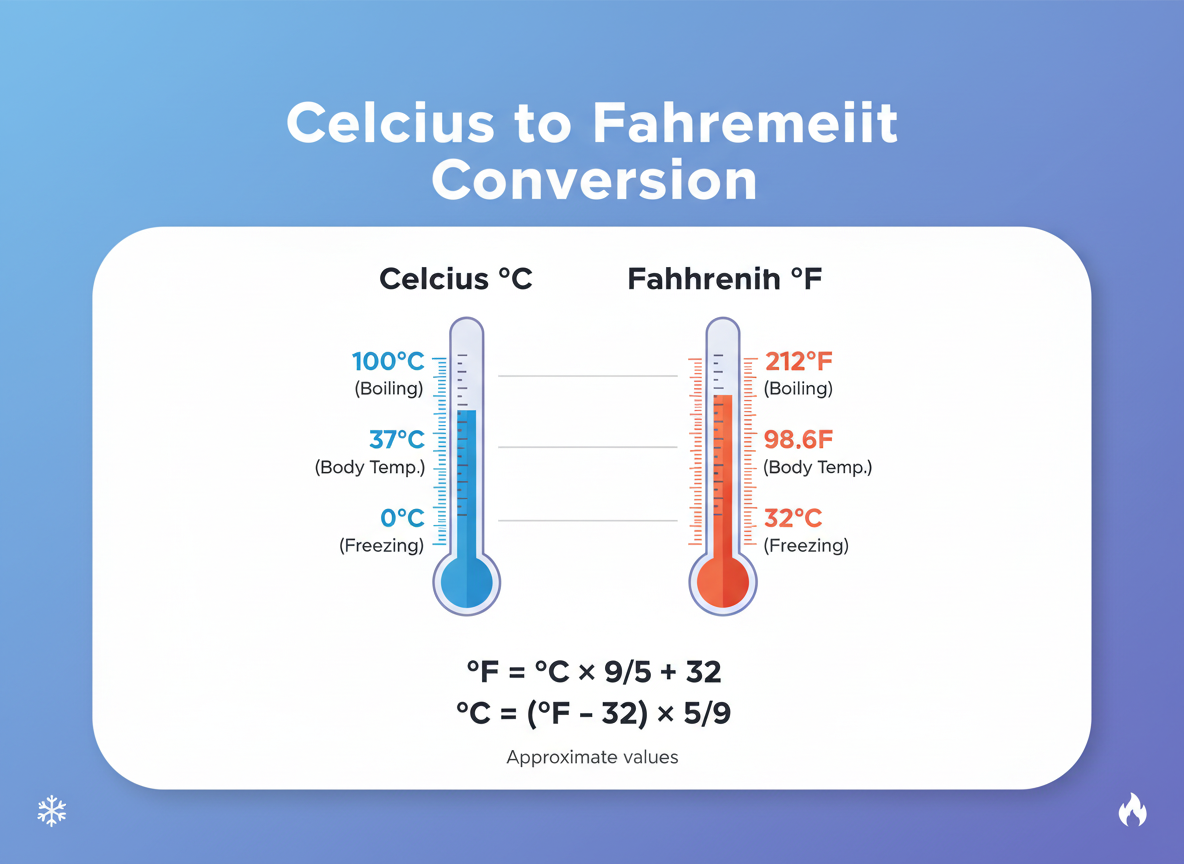
The Celsius scale, also known as the centigrade scale, is part of the metric system and is used by most countries worldwide. It is based on the freezing and boiling points of water, where 0°C represents the freezing point and 100°C represents the boiling point at standard atmospheric pressure.
Celsius is widely used in scientific research, weather reporting, and everyday temperature measurements. Because it is part of the International System of Units (SI), it is the standard unit for temperature in most global applications.
What Is Fahrenheit?
The Fahrenheit scale is primarily used in the United States and a few other regions. In this system, water freezes at 32°F and boils at 212°F. The scale was developed by Daniel Gabriel Fahrenheit and is still widely used in weather forecasts, cooking, and daily temperature readings in certain countries.
Understanding Fahrenheit is important for interpreting temperature data in regions where this system is still dominant.
Celsius to Fahrenheit Formula
To convert Celsius to Fahrenheit, use the following formula:
°F = (°C × 9/5) + 32
This formula works by scaling the Celsius value and then shifting it to match the Fahrenheit scale. The multiplication factor (9/5) adjusts for the difference in scale size, while adding 32 aligns the freezing points.
Step-by-Step Conversion Example
Let’s convert 25°C to Fahrenheit:
- Step 1: Multiply 25 × 9/5 = 45
- Step 2: Add 32 → 45 + 32 = 77
- Final Answer: 25°C = 77°F
This simple process can be applied to any temperature value for quick and accurate conversions.
Why Temperature Conversion Matters
Temperature conversion is critical in many real-world applications. In science and engineering, accurate temperature measurement ensures correct experimental results and safe operation of equipment. In cooking, converting between Celsius and Fahrenheit ensures recipes are followed correctly, especially when using international cookbooks.
Travelers also benefit from understanding temperature conversions, as weather conditions are reported differently across countries. Knowing how to convert temperatures helps you prepare appropriately for different climates.
Common Use Cases
There are several situations where converting Celsius to Fahrenheit is essential:
- Checking weather forecasts when traveling internationally
- Using recipes from different countries
- Scientific calculations and laboratory experiments
- Industrial processes and engineering systems
- Medical temperature readings
In all these scenarios, having a quick and reliable conversion method saves time and prevents mistakes.
Quick Mental Conversion Trick
If you need a fast estimate without using a calculator, you can use this trick:
- Double the Celsius value
- Add 30
For example:
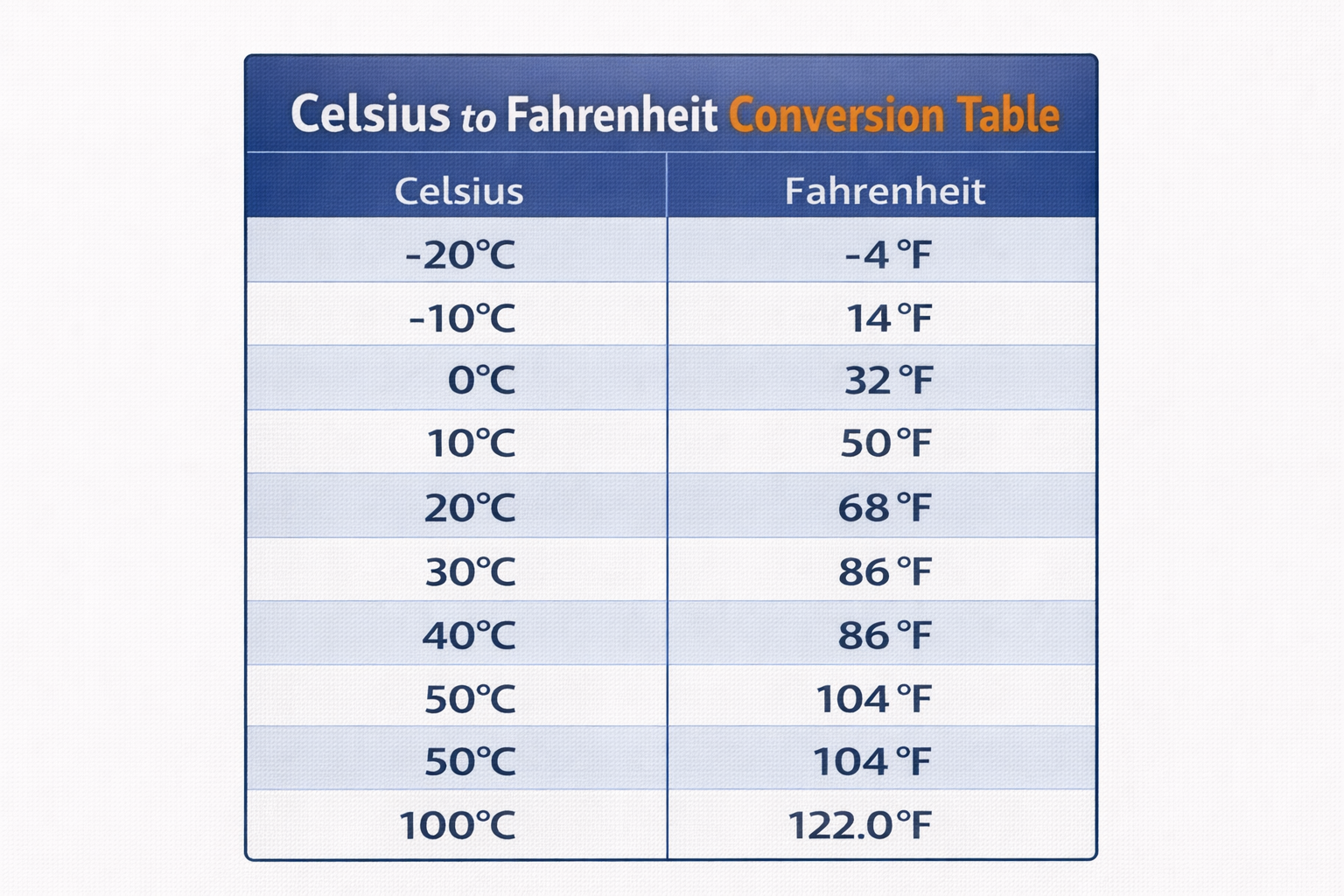
20°C → (20 × 2) + 30 = 70°F (actual value is 68°F)
This method provides a quick approximation that is close enough for everyday use.
Celsius vs Fahrenheit Differences
The main difference between Celsius and Fahrenheit lies in how the scales are defined. Celsius is based on the properties of water, while Fahrenheit uses a different reference system. As a result, the size of each degree differs between the two scales.
Celsius is simpler for scientific use because it is part of the metric system and follows a decimal structure. Fahrenheit, on the other hand, provides more granular temperature readings in everyday conditions, which is why it remains popular in some regions.
History of Temperature Scales
The Celsius scale was developed by Swedish astronomer Anders Celsius in the 18th century. Initially, the scale was reversed, with 0 representing boiling and 100 representing freezing, but it was later inverted to the modern format.
The Fahrenheit scale was introduced earlier by Daniel Gabriel Fahrenheit. It was based on a mixture of ice, water, and salt for its zero point, and human body temperature was originally set at 96°F.
Both systems have evolved over time, but they remain widely used today for different purposes.
Tips for Accurate Conversion
To ensure accuracy when converting Celsius to Fahrenheit:
- Always use the correct formula
- Avoid rounding too early in calculations
- Use a calculator for precise results
- Double-check units before converting
Using a reliable online converter is often the fastest and most accurate method.
Conclusion
Converting Celsius to Fahrenheit is a simple yet essential skill used in everyday life, science, and industry. By understanding the formula and practicing a few examples, you can quickly convert temperatures with confidence. Whether you’re cooking, traveling, or studying, accurate temperature conversion ensures better results and a deeper understanding of the world around you.
Most Used Conversions
Frequently Asked Questions
How do you convert Celsius to Fahrenheit Conversion?
To convert between units, multiply the value by the correct conversion factor. Our calculator automatically applies this formula to give you an instant and accurate result.
What is the formula for Celsius to Fahrenheit Conversion?
The conversion formula is based on a fixed relationship between the two units. In general, you multiply the input value by a constant factor to get the converted result.
Is this conversion calculator accurate?
Yes. This tool uses standardized conversion formulas and internationally accepted measurement definitions to ensure precise results.
Can I convert decimal values?
Yes. You can enter decimal numbers and the calculator will return highly accurate results instantly.
Why is unit conversion important?
Unit conversion ensures consistency across different measurement systems such as metric and imperial. It is essential in science, engineering, construction, and everyday calculations.
Which measurement systems are supported?
This converter supports both metric (SI units) and imperial systems, allowing accurate conversions across different standards.
Can I use this tool on mobile devices?
Yes. The converter is fully responsive and works on mobile phones, tablets, and desktop devices.
Is this tool free to use?
Yes. The converter is completely free and available for unlimited use without any restrictions.