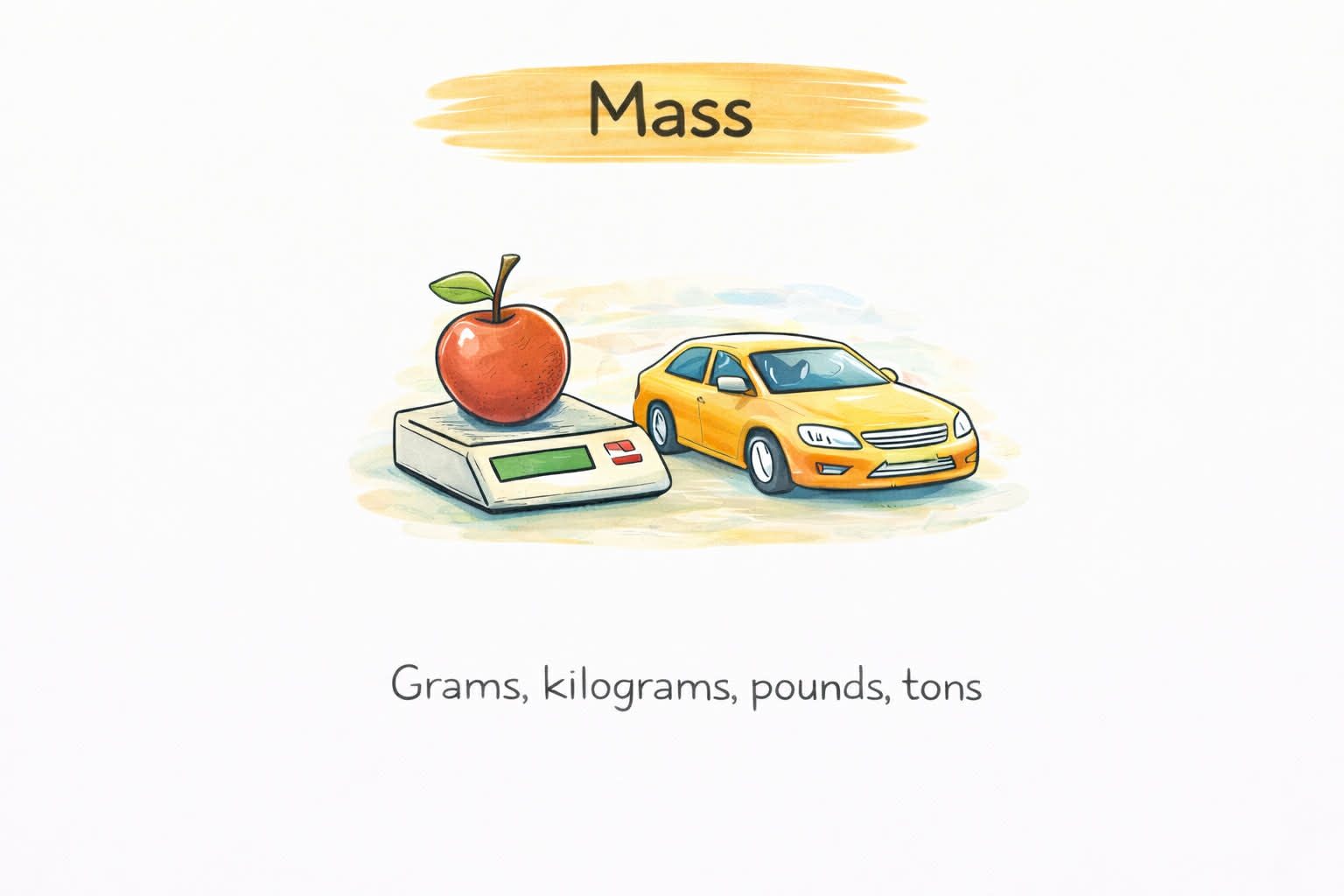
Convert mass units such as kilograms, grams, pounds, and ounces with high precision. Perfect for cooking, fitness tracking, science, and industrial measurements where accuracy matters.
What is Mass Conversion?
Mass conversion is the process of converting a measurement from one unit of mass into another while preserving the same physical quantity.
It allows different measurement systems to represent identical weights using different units.
Mass is one of the fundamental physical properties of matter and is widely used in science, engineering, trade, and everyday life.
Accurate conversion ensures consistency when working across international standards and different industries.
The most commonly used systems for measuring mass are the metric system and the imperial system.
Understanding how these systems relate is essential for accurate calculations and global communication.
Why Mass Conversion is Important
Mass conversion plays a critical role in both everyday activities and professional industries.
Incorrect conversions can lead to errors in calculations, product measurements, and safety standards.
Cooking and Nutrition: Recipes often require converting grams to ounces or pounds
Shipping and Logistics: Package weight affects cost and regulations
Science and Engineering: Accurate mass measurements are essential for experiments and design
Healthcare: Medication dosages rely on precise weight calculations
International Trade: Goods must comply with different unit systems worldwide
Even small inaccuracies in mass conversion can lead to significant consequences, especially in precision-based industries.
How Mass Conversion Works
Mass conversion is based on fixed mathematical relationships between units.
These relationships are standardized and used globally to ensure accuracy.
Most conversions follow a simple process:
Convert the original value into a base unit (typically kilograms)
Convert from the base unit into the desired unit
1 kilogram = 1000 grams
1 pound = 0.453592 kilograms
1 ounce = 28.3495 grams
Using this method ensures consistency across all conversions.
Metric vs Imperial Mass Systems
⚖️ Metric System
Based on powers of ten, making conversions simple and consistent.
1 kilogram = 1000 grams
1 gram = 1000 milligrams
Widely used worldwide
📦 Imperial System
Used mainly in the United States with non-decimal relationships.
1 pound = 16 ounces
1 ton = 2000 pounds
More complex conversion structure
Common Mass Conversions
1 kilogram = 2.20462 pounds
1 pound = 0.453592 kilograms
1 gram = 0.035274 ounces
1 ounce = 28.3495 grams
1 milligram = 0.001 grams
1 ton = 1000 kilograms
These values are standardized and widely used across industries and everyday applications.
Real-Life Examples of Mass Conversion
A 70 kg person weighs about 154 pounds
A 500 g package equals 0.5 kilograms
A 16 oz product equals 1 pound
A 1 ton shipment equals 1000 kilograms
These examples demonstrate how mass conversion helps translate measurements into familiar units.
Pharmaceuticals: Accurate dosing depends on precise mass calculations
Aviation: Aircraft weight calculations are critical for safety
Food Industry: Ingredient measurements must be consistent
Logistics: Shipping weight affects pricing and compliance
Advantages of Using an Online Mass Converter
Instant and accurate results
Supports metric and imperial units
Reduces calculation errors
Easy to use for all experience levels
Tips for Accurate Mass Conversion
Always verify units before converting
Use reliable tools or formulas
Avoid early rounding of values
Understand basic unit relationships
Conclusion
Mass conversion is an essential skill used across industries and daily life.
From cooking and healthcare to engineering and logistics, accurate conversions ensure precision and efficiency.
Using reliable tools and understanding unit relationships allows you to perform mass conversions quickly and confidently.
Dynamic Mass Converter
=0
Sources & Standards
International System of Units (SI)
National Institute of Standards and Technology (NIST)
ISO Measurement Standards
All conversion values on this page are based on globally accepted measurement standards.
💡 Did you know?
Conversion Table (1-10)
Visual Conversion Diagram
Understanding Mass Units in Detail
Mass is a fundamental physical quantity used across science, engineering, and everyday life.
It is measured using different unit systems depending on the region, industry, and application.
The metric system provides a standardized and scalable approach based on powers of ten, while other systems such as the imperial system use different relationships between units.
This is why reliable conversion tools are essential for accurate calculations and global communication.
Popular Mass Conversions
Below are some of the most frequently used mass conversions used in science, engineering, travel, and everyday measurements.
In engineering and aviation, even small conversion errors can lead to serious consequences.
For example, incorrect unit conversion has historically caused system failures and costly mistakes.
Mass Conversions (kg, g, lb, oz & more)
Browse all available mass conversion tools below.
Each converter provides accurate calculations based on internationally recognized measurement standards.
Mass conversion is the process of translating a measurement from one unit into another unit that represents the same quantity.
Different industries and countries often use different measurement systems, which makes reliable conversion tools essential for accurate calculations.
The calculator on this page allows you to convert between commonly used mass units instantly.
By entering a value and selecting the desired units, the tool automatically applies standardized mathematical formulas to generate precise results.
Whether you are working with metric measurements or imperial units, accurate unit conversions help ensure consistency across engineering, science, education, and everyday applications.
💡 Real-life facts
Related Mass Conversion Searches
These commonly searched mass conversion queries help users quickly find accurate measurement results.
Find answers to common questions about mass conversions, formulas, accuracy, and measurement systems.
Mass unit conversion is the process of converting a measurement from one unit into another while maintaining the same value.
This is commonly used when working between different systems such as the metric system and the imperial system.
Using accurate conversion formulas ensures consistency in scientific calculations, engineering work, and everyday tasks.
Mass conversion works by applying a conversion factor that defines the relationship between two units.
For example, one unit is multiplied or divided by a constant value to obtain the equivalent measurement in another unit.
Modern online converters automate this process to provide instant and highly accurate results.
Mass conversion is essential in many industries including engineering, science, travel, construction, and education.
Different countries use different measurement systems, so converting units ensures accurate communication and prevents costly errors in calculations.
A conversion factor is a numerical value that expresses how one unit relates to another.
For example, in many Mass conversions, one unit can be converted by multiplying by a fixed constant.
These factors are standardized and based on internationally accepted measurement systems.
Mass measurements are typically based on two main systems: the metric system and the imperial system.
The metric system is used globally and is based on powers of ten, while the imperial system is still used in certain countries and industries.
This converter supports both systems for seamless conversion.
Yes, this Mass converter uses internationally recognized formulas and precise conversion constants.
All calculations are performed using accurate values to ensure reliable results suitable for both professional and everyday use.
Yes, this tool supports decimal values, allowing precise Mass conversions for both small and large measurements.
This is especially important in scientific and engineering applications where accuracy is critical.
The most common Mass conversions depend on the category.
For example, users often convert between popular units used in daily life, industry, and international standards.
This page provides quick access to the most frequently used conversion combinations.
The fastest way to convert Mass units is by using an online converter like this one.
Simply enter a value, select your units, and the result is calculated instantly.
This eliminates manual calculations and reduces the risk of errors.
Yes, Mass conversion formulas are based on internationally accepted standards such as the SI (International System of Units).
These standards ensure that conversions are consistent, accurate, and universally recognized across different fields and industries.
Reviewed by measurement specialists. All conversion formulas follow
internationally recognized standards including SI (International System of Units)
and NIST guidelines.